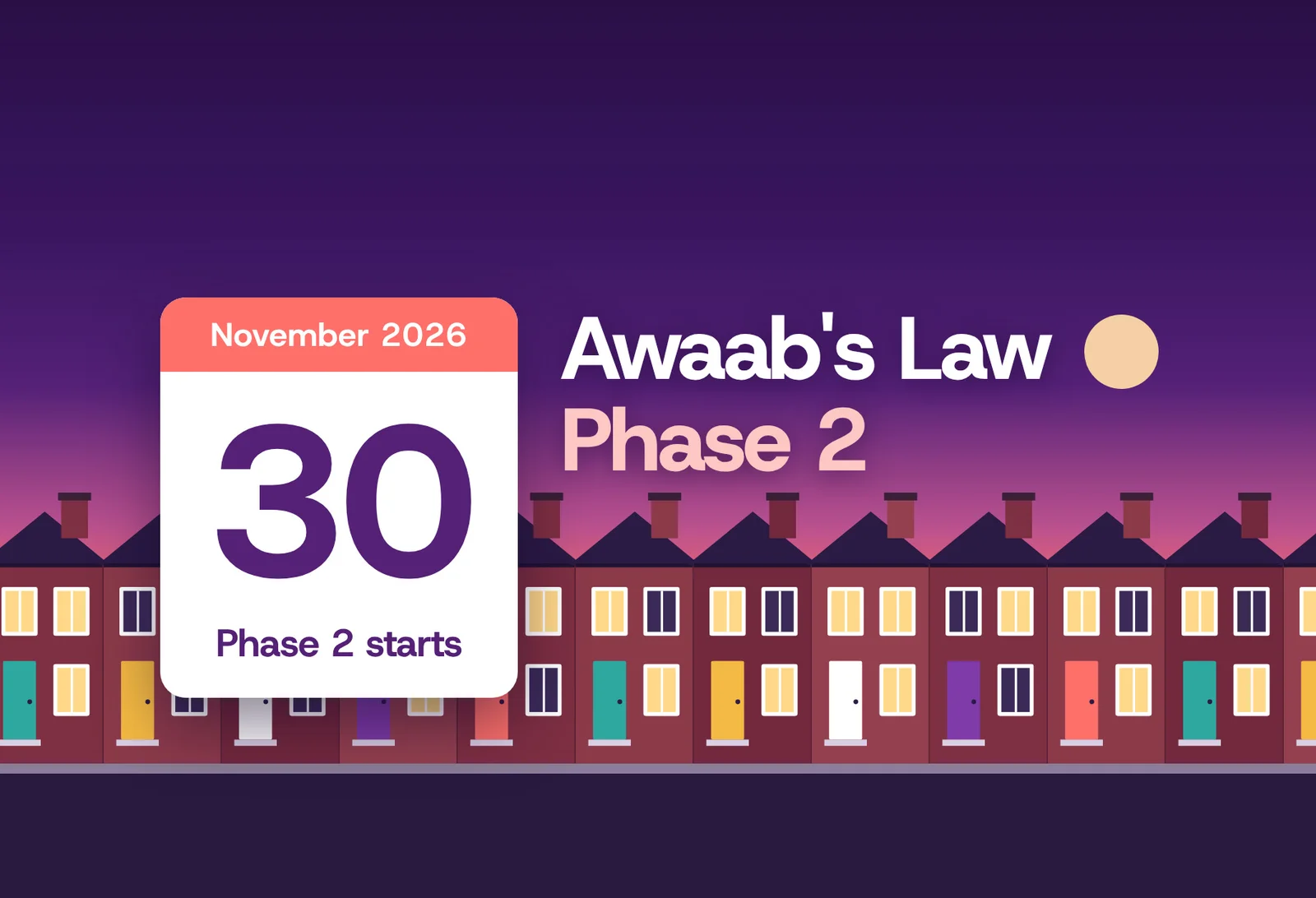
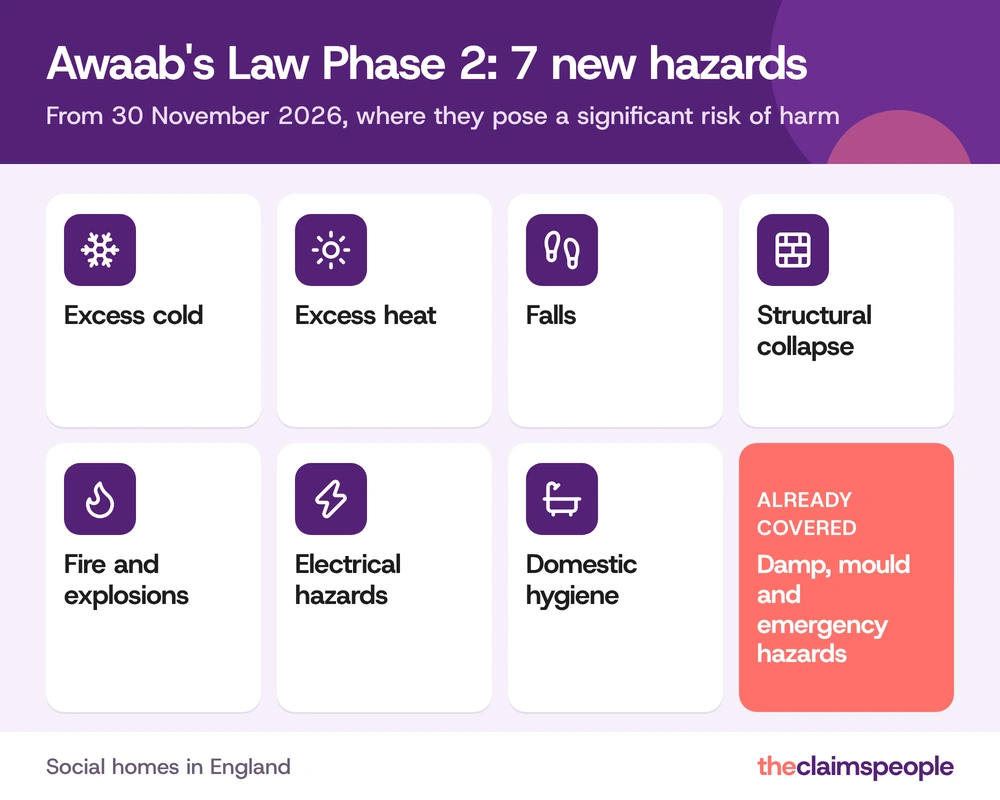
Awaab's Law Phase 2 starts on 30 November 2026. It adds seven hazards: excess cold, excess heat, falls, structural collapse, fire and explosions, electrical hazards and domestic hygiene. Where one poses a significant risk, your council or housing association in England must investigate and make your home safe within fixed deadlines.

What is Awaab's Law Phase 2?
Awaab's Law Phase 2 is the next stage of the law that gives social landlords in England fixed deadlines to deal with dangerous homes. The law is named after Awaab Ishak, a two year old boy who died in 2020 after long exposure to mould in his family's home in Rochdale.
Phase 1 began on 27 October 2025. It covers all emergency hazards except overcrowding, and damp and mould that poses a significant risk to your health or safety.
Phase 2 goes much further. Parliament approved the new rules in October 2026. From 30 November, the same deadlines apply to seven more types of hazard when they pose a significant risk of harm.
For the full background, read our guide to Awaab's Law. This page deals with what is new.
The seven new hazards in Awaab's Law Phase 2
The hazards come from the Housing Health and Safety Rating System, known as the HHSRS. The government's guidance for landlords explains how the rules work. These are the kinds of problem it has in mind.
Tap a hazard to see what it can look like
These are examples only. Your landlord looks at the risk in your home.
Excess cold. A home you cannot heat or keep at a safe temperature.
For example: A broken boiler, radiators that have stopped working or a window that will not close.
Read more: Broken heating claims
Excess heat. A home that gets dangerously hot because of a defect.
For example: A window that will not open, or heating that cannot be turned off.
Falls. Falls on stairs, on the level or between levels.
For example: An unsafe banister or broken balcony railings.
Structural collapse. Part of the building failing or at risk of falling.
For example: Rotten ceiling joists.
Read more: Defective brickwork claims
Fire and explosions. Fire risks inside your own home.
For example: A broken or missing smoke alarm.
Domestic hygiene. Problems that stop you keeping your home clean and healthy.
For example: Pests linked to defects in the building, drains that keep failing or no way to wash.
Read more: Pest infestation claims and blocked drains claims
How hazards are judged under Awaab's Law
Not every fault will qualify. The test is what a reasonable landlord would do. If a reasonable landlord, knowing about your household, would make the problem safe within 15 working days, it is a significant hazard. If they would make it safe within 24 hours, it is an emergency hazard.
The same fault can be far more serious for one family than for another. A broken boiler in January is a bigger risk for an older tenant than it is for a fit adult in a mild week.
Your landlord has to take your circumstances into account, including age, health and disability. So tell them who lives in your home and whether anyone has a health condition. The guidance says landlords should generally take what you tell them at face value, and you do not need medical evidence.
A hazard also does not need to reach category 1, the top level under the HHSRS. Awaab's Law looks at the real people living in your home.
Awaab's Law timescales from 30 November 2026
The Awaab's Law timescales stay the same in Phase 2. They now apply to more problems.
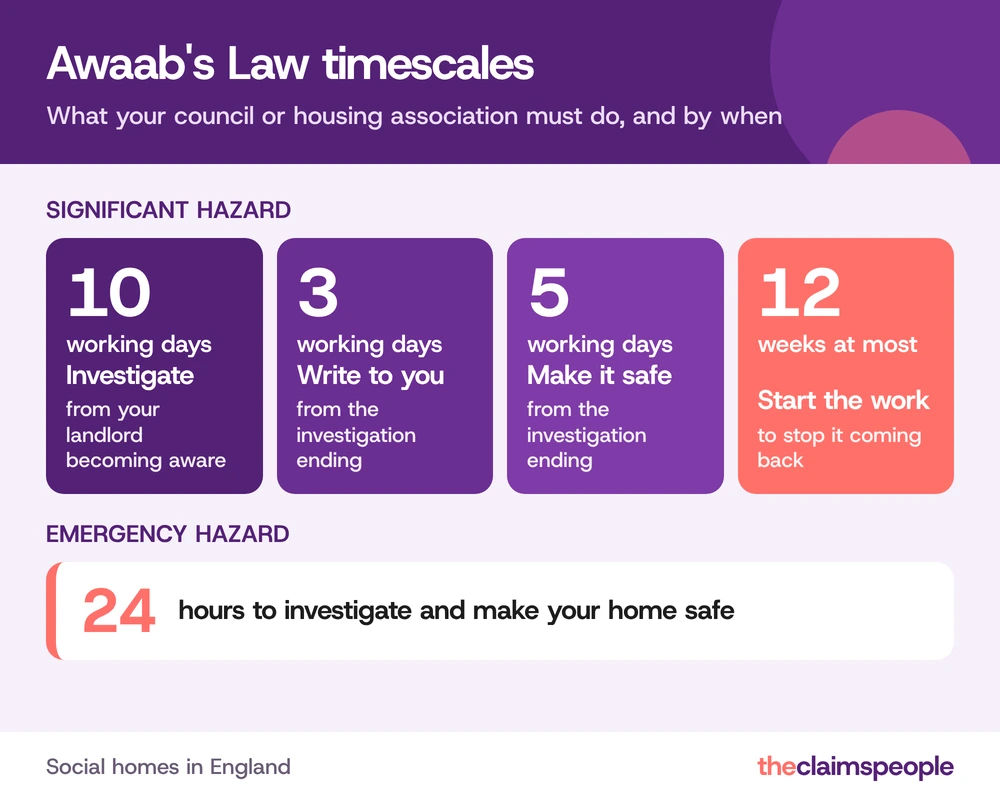
What must happen | Significant hazard | Emergency hazard |
|---|---|---|
Investigate | Within 10 working days of your landlord becoming aware | Within 24 hours of your landlord becoming aware |
Make your home safe | Within 5 working days of the investigation ending | Within 24 hours of your landlord becoming aware |
Written summary of what they found | Within 3 working days of the investigation ending | Within 3 working days of the investigation ending |
Start work to stop it coming back | Within 5 working days of the investigation ending, or as soon as reasonably practicable and within 12 weeks at the latest | Within 5 working days of the investigation ending, or as soon as reasonably practicable and within 12 weeks at the latest |
The 24 hour clock starts as soon as your landlord becomes aware. The other deadlines start the day after. If all the work is finished within 3 working days of the investigation ending, your landlord does not have to send a written summary, but they must still tell you it is done.
Work out your landlord's deadlines
Pick the problem and the date you told them.
What does making your home safe mean?
It does not always mean the full repair is finished. Your landlord can use temporary measures first, such as portable heaters while a boiler is fixed, or closing off an unsafe area. They must then deal with the cause.
If they cannot make your home safe in time, they must secure suitable alternative accommodation for your household at their own expense. It is your choice whether to accept.
Can you ask for an inspection in person?
Usually, yes. If your landlord looks at the problem remotely, using your photos or video, you can ask for someone to come in person. That visit must then happen within 10 working days of your request.
Living with one of these hazards?
Answer 4 quick questions to see what to do next.
Reported the problem before 30 November?
This is the part most tenants will miss. The new deadlines are triggered when your landlord becomes aware of a hazard after the rules begin. They do not automatically reach back to a report you made in the summer.
The guidance does give you a way in. If your landlord already knew about a hazard and you report a concern about it after the rules begin, the requirements apply from the point of that report. The same goes if the problem changes, for example it gets worse or starts to affect someone's health.
So if you have been living with a faulty socket, a broken stair rail or a home you cannot heat, report it now, and report it again on or after 30 November. Do it in writing and keep a copy.
Your older reports still count for something. Your landlord's repairing duties under Section 11 of the Landlord and Tenant Act 1985 did not start with Awaab's Law, and the date you first told them can be important evidence.
Do not wait if it is an emergency
Emergency hazards are covered now, so nothing needs to wait until 30 November. If something could cause immediate harm, such as exposed wiring, a major leak or a broken boiler in cold weather, your landlord should be acting within 24 hours.
If you smell gas or think there may be a carbon monoxide leak, call the National Gas Emergency Service straight away on 0800 111 999.
What Awaab's Law Phase 2 does not cover
Awaab's Law has limits. These fall outside it:
Damage caused by a breach of your tenancy, such as deliberate damage or blocking a ventilation fan
Overcrowding
Cladding work, which is dealt with under fire safety law
Fire safety problems in the communal areas, structure or outside walls of a block of flats, or with flat front doors, which have their own rules
Problems in parts of a building your landlord is not responsible for
Problems that can only be made safe through large scale structural work, such as some large panel system blocks
Damage from accidents such as fire, storm or flood, and appliances you own
Homes held on a licence rather than a tenancy, shared ownership homes and long leases
Report the problem anyway. Your landlord still has other legal duties to keep your home safe, even where Awaab's Law does not apply.
Everyday living is unlikely to be a breach of your tenancy. The guidance says it is unacceptable for landlords to assume a hazard such as damp, mould or pests comes down to a tenant's lifestyle.
What tenants should do before 30 November
You do not have to be the one who reports it. A friend, neighbour, support worker or solicitor can raise it for you, which helps if you are looking out for a parent or a relative.
Report the problem through your landlord's official route. Say who lives in your home and whether anyone's health is affected.
Follow up any phone call in writing. Keep the date, the name of the person you spoke to and any reference number.
Take dated photos or video of the problem.
Keep every letter, text and email, including any written summary.
Report it again on or after 30 November if it is one of the new hazards.
If a deadline passes, use your landlord's complaints process.
If that fails, go to the Housing Ombudsman or take legal advice.
What if your landlord misses a deadline?
The deadlines are written into your tenancy, so missing one can be a breach of contract. You can use the complaints process, go to the Housing Ombudsman, or ask a solicitor about a housing disrepair claim.
A court can order repairs, compensation and costs. Your landlord has a defence if they can prove they used all reasonable endeavours to comply, for example where they tried again and again to get access. So keep a note of every appointment you offered and every visit that did not happen.
Awaab's Law does not create a set payment for a missed deadline. Depending on your circumstances, you may be able to pursue repairs and compensation for the time you have lived with the problem.
Claims like this are normally funded on a no win no fee basis. There is nothing to pay upfront and no fee to us if your claim does not succeed. If it succeeds, deductions apply, and every deduction is set out in writing before you sign anything. Our no win no fee guide explains how it works.
What is Awaab's Law Phase 3?
Phase 3 is the final stage. The government plans to bring it in during 2027, and it will cover the remaining HHSRS hazards apart from overcrowding.
Does Awaab's Law Phase 2 apply in Wales?
No. Awaab's Law applies to social homes in England. In Wales, the Renting Homes (Wales) Act 2016 requires landlords to keep homes in repair and fit for human habitation. We act for council and housing association tenants in Wales too.
Related guides
Frequently asked questions
When does Awaab's Law Phase 2 start?
Awaab's Law Phase 2 starts on 30 November 2026. Parliament approved the regulations in October 2026.
What hazards does Awaab's Law Phase 2 add?
Excess cold, excess heat, falls, structural collapse, fire and explosions, electrical hazards and domestic hygiene, which includes personal hygiene and food safety. They are covered where they pose a significant risk of harm.
What are the Awaab's Law timescales?
Your landlord has 10 working days to investigate a significant hazard and 5 working days after that to make your home safe. Emergency hazards must be investigated and made safe within 24 hours. Phase 2 does not change these timescales.
Are pests covered by Awaab's Law?
Yes. A serious infestation that poses an immediate threat to health can already be an emergency hazard. From 30 November 2026, ongoing infestations linked to defects in the building can also be a significant hazard.
I reported my problem before 30 November. Does it count?
Report it again on or after 30 November. The guidance says that if your landlord already knew about a hazard and a concern is reported after the rules begin, the requirements apply from the point of that report.
Will there be an Awaab's Law Phase 3?
Yes. The government plans a third phase in 2027 covering the remaining hazards, apart from overcrowding.
Does Awaab's Law apply to my landlord?
It applies to registered providers of social housing in England, which means councils and housing associations. Homes held on a licence rather than a tenancy are not covered.
Reported a hazard and still waiting?
Tell us what the problem is and when you reported it. Depending on your circumstances, you may be able to pursue repairs and compensation for the time you have lived with it. Free to check, no obligation.
Check if you can claimThis page is general information, not legal advice. Every claim turns on its own facts. Speak to a qualified solicitor about your circumstances. Last checked 5 November 2026.