Emergency repairs council and housing association tenants can report are problems that could cause immediate harm, such as exposed wiring, a major leak or a broken front door. In England, your landlord must investigate an emergency hazard and make your home safe within 24 hours of becoming aware of it.

What counts as an emergency repair?
An emergency repair is a fault that could put someone's health or safety at risk straight away, or leave your home unsafe. Under Awaab's Law, an emergency hazard is one that could cause immediate harm if it is not dealt with within 24 hours.
There is no single legal list. The government's guidance for social landlords gives these examples of what could be an emergency:
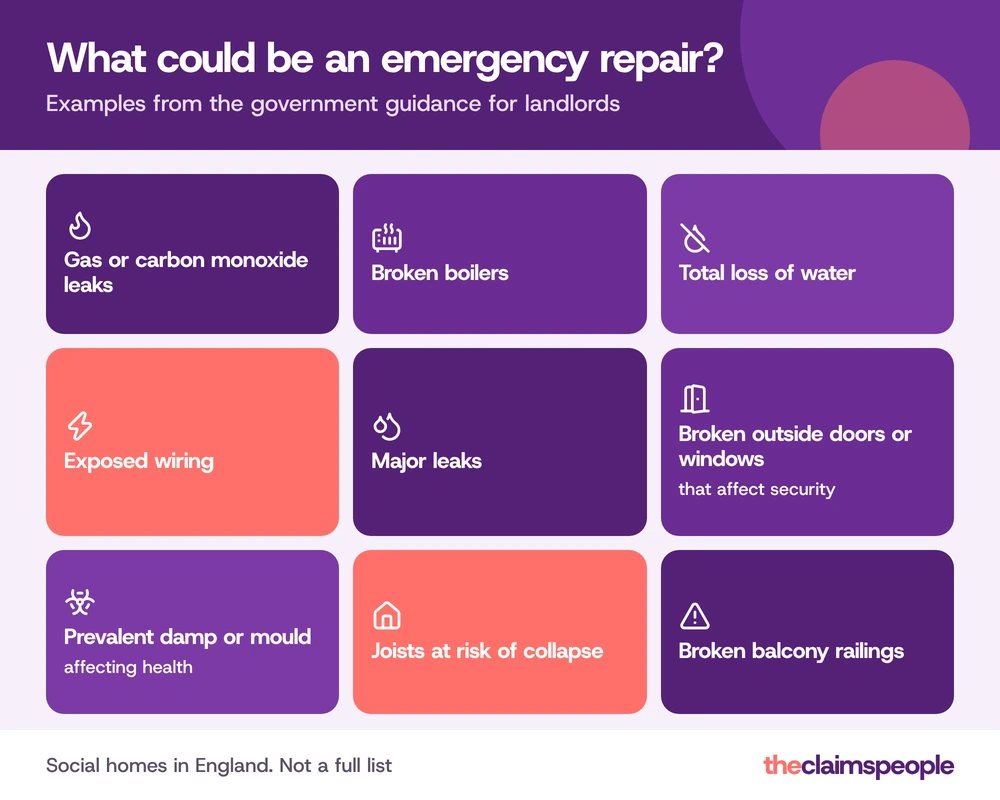
Your landlord may have its own list too, so check your tenant handbook or website.
What matters most is the risk in your home. The same fault can be an emergency for one family and not for another.
Is no heating an emergency repair?
It can be. Broken boilers are on the guidance list, and it says they are likely to be more serious in colder months. Our guide on how long a landlord can leave you without heating goes through the rules, and our page on broken heating claims explains what can happen next.
Is a leak an emergency repair?
A major leak can be. Our guide on what to do about a leak from ceiling explains how to tell the difference and what to do first.
Is a broken front door an emergency repair?
A broken outside door or window can be, where it affects the security of your home. In one of the guidance's own examples, a broken door lock was reported with a video, judged an emergency and fixed the same day.
Is damp and mould an emergency repair?
It can be, where it is prevalent and having a real effect on someone's health. Read our guide on whether black mould is dangerous for the signs to look out for.
What to do for each emergency
Tap a problem to see who to call first.
Gas smell or carbon monoxide alarm. Do not wait for your landlord. Open doors and windows, do not use electrical switches or naked flames, and turn off the gas at the meter if you can reach it safely. If a carbon monoxide alarm sounds or anyone feels unwell, get everyone into fresh air. Call the National Gas Emergency Service on 0800 111 999 straight away, then tell your landlord. If anyone is seriously unwell, call 999.
No power. Check your meter has credit and look at your fuse box. If neighbours have lost power too, call 105. If it is only your home, call your landlord's emergency line.
Read more: Faulty electrics claims
No water at all. If neighbours have lost water too, call your water company. If it is only your home, call your landlord's emergency line.
Exposed wiring or a burning smell. Do not touch it. If you can reach the fuse box safely, switch it off and call your landlord's emergency line. If there is smoke or fire, get out and call 999.
Broken outside door or window. Call your landlord's emergency line and tell them your home is not secure.
The 24 hour rule for emergency repairs
In England, Awaab's Law has covered emergency hazards in council and housing association homes since 27 October 2025. Your landlord must investigate an emergency hazard and make your home safe within 24 hours of becoming aware of it.
The clock starts as soon as they know, not the next working day, so nights, weekends and bank holidays count. Many landlords run an emergency repairs line outside office hours, so find out how yours works before you need it.
What does make safe mean?
It does not always mean the whole repair is finished. Your landlord can use temporary measures, such as portable heaters while a boiler is fixed. They still have to deal with the fault afterwards.
If they cannot make your home safe in time, they must secure suitable alternative accommodation at their own expense. You can accept that offer or turn it down.
Who does the 24 hour rule cover?
It applies to registered providers of social housing in England, which means councils and most housing associations. Homes held on a licence rather than a tenancy are not covered, but temporary and supported housing is if you have a tenancy agreement.
Emergency, urgent or routine repair?
Landlords sort repairs into priorities, and the names vary. The legal rules behind them look like this.
Type of problem | Rule that can apply | How long |
|---|---|---|
Emergency hazard | Awaab's Law, England | Investigate and make safe within 24 hours |
Listed small repair, such as an insecure outside door or a leak from a water pipe | Right to Repair, secure and introductory council tenants in England, repairs expected to cost £250 or less | 1 working day |
Significant damp and mould hazard | Awaab's Law, England | Investigate within 10 working days, then make safe within 5 working days of the investigation ending |
Other repairs | Section 11, most social tenants in England | A reasonable time after your landlord is told |
The legal Right to Repair scheme does not cover housing association tenants, though many run a similar scheme. From 30 November 2026, Awaab's Law Phase 2 brings more hazards under the 10 and 5 working day deadlines, including excess cold, falls and electrical hazards. Our guide to landlord repair responsibilities covers who fixes what.
Work out your landlord's deadlines
In England. Pick the problem and the date you told them.
How to report an emergency repair out of hours
Save your landlord's emergency repairs number in your phone now. It is usually on their website, or in your tenant handbook.
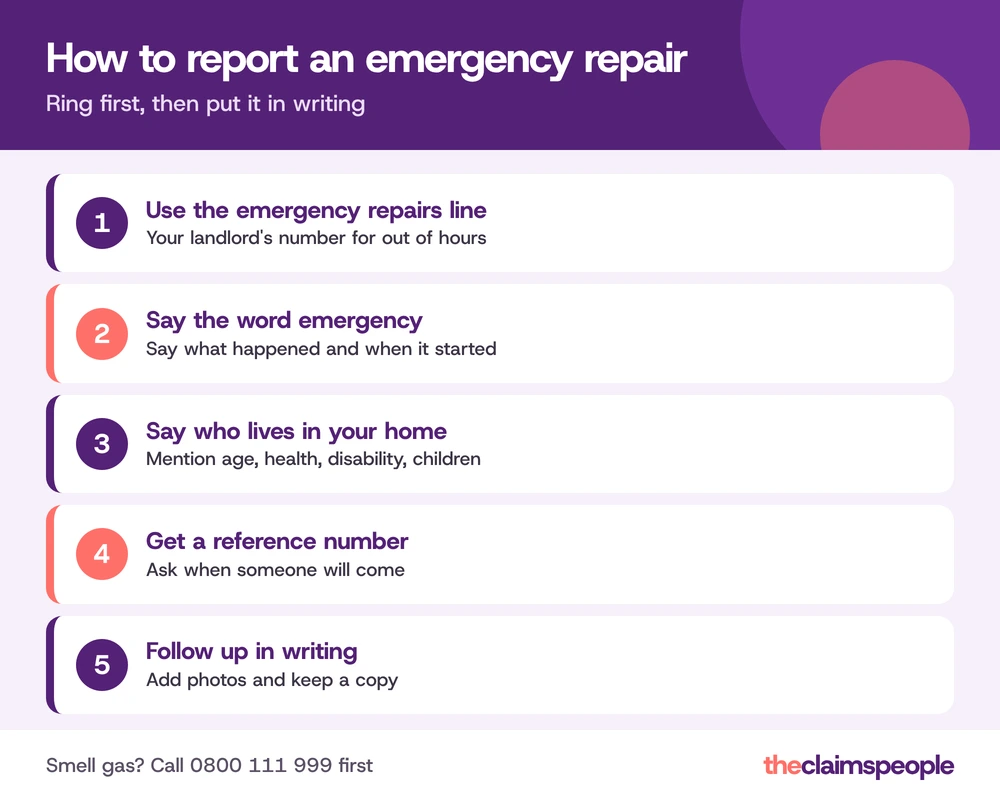
Ring the emergency repairs line. Do not rely on an email or a form out of hours.
Use the word emergency. Say what has happened and when it started.
Say who lives in your home, including children, older people and anyone with a health condition or disability. You do not need medical evidence.
Ask for a reference number and when someone will come.
Follow up in writing as soon as you can, with photos or a short video.
Keep a note of every call, who you spoke to and any visit.
You do not have to be the one who reports it. A friend, neighbour, support worker or solicitor can tell your landlord for you.
What if nobody comes for an emergency repair?
Ring again. Quote your reference number and follow it up in writing the same day.
If there is immediate danger, do not wait. Call 999, or 0800 111 999 for gas.
After that, use your landlord's complaints process, then go to the Housing Ombudsman in England or the Public Services Ombudsman for Wales in Wales. If your landlord is a housing association, you can also ask your council's environmental health team to look at it.
Be careful about paying for your own repair. Do not take the cost out of your rent without advice first, because arrears can put your home at risk. Keep every receipt.
Reported an emergency and nobody came?
Answer 4 quick questions to see what to do next.
Will you be charged for an emergency repair?
Normally not, where the repair is your landlord's responsibility. Some landlords charge for call outs where the damage was caused by the tenant or the job turns out not to be theirs to fix. Check your landlord's repairs policy, and ask before agreeing to pay anything. Do not let the worry stop you reporting something dangerous.
Can you claim if an emergency repair was not done?
You may be able to, depending on your circumstances. A claim usually comes down to whether you told your landlord, whether you can show it, whether they had enough time to fix it and whether they failed to do so. Awaab's Law does not create a set payment for a missed deadline.
A claim can cover getting the work done, compensation for the time you lived with the problem and extra costs you can show. Read can I sue my landlord for not doing repairs? and our guide to housing disrepair compensation.
Claims like this are normally funded on a no win no fee basis. There is nothing to pay upfront and no fee to us if your claim does not succeed. If it succeeds, deductions apply, and every deduction is set out in writing before you sign anything. Our no win no fee guide explains how it works.
What about Wales?
Awaab's Law and its 24 hour rule apply in England only, and Section 11 does not apply to occupation contracts in Wales. Instead, the Renting Homes (Wales) Act 2016 requires your landlord to keep your home in repair and fit for human habitation, and to carry out repairs within a reasonable time of finding out. Since 1 April 2026, the Welsh Housing Quality Standard has also set timescales for social landlords. Where disrepair poses a significant risk, the limits are 24 hours to investigate and a further 24 hours to put it right if harm is likely to be imminent, or otherwise 10 working days and a further 5 working days. Social landlords in Wales must also publish their response times, so check your landlord's website or repairs policy.
Related guides
Frequently asked questions
What counts as an emergency repair for council tenants?
A fault that could cause immediate harm or leave your home unsafe. Government guidance gives examples such as gas leaks, broken boilers, total loss of water, exposed wiring, major leaks and broken outside doors. Your landlord's own list may add others.
How long does the council have to do an emergency repair?
In England, if it is an emergency hazard, the council must investigate and make your home safe within 24 hours of becoming aware of it. The full repair can take longer if temporary measures make your home safe first.
Is no hot water an emergency repair?
It can be, depending on the risk to your household. Tell your landlord who lives in your home and whether you can wash. For council tenants, the Right to Repair may also apply to listed repairs.
Who do I call for a council emergency repair out of hours?
Ring your landlord's emergency repairs number, which is usually on their website or in your tenant handbook. If you smell gas, call 0800 111 999 first. If there is immediate danger, call 999.
Does the 24 hour rule apply to housing associations?
Yes. Awaab's Law applies to registered providers of social housing in England, which includes councils and most housing associations. Awaab's Law does not apply in Wales, but social landlords there have their own hazard timescales under the Welsh Housing Quality Standard.
Can I be charged for an emergency call out?
Some landlords charge where the tenant caused the damage or the job turns out not to be theirs to fix. Repairs that are your landlord's responsibility are normally free to you. Check your repairs policy.
What if my landlord does not come?
Ring again, quote your reference number and follow up in writing. Then use the complaints process and go to the Housing Ombudsman in England or the Public Services Ombudsman for Wales. If there is danger, call 999.
Reported an emergency and still waiting?
Tell us what the problem is and when you reported it. Depending on your circumstances, you may be able to pursue repairs and compensation for the time you have lived with it. Free to check, no obligation.
Check if you can claimThis page is general information, not legal advice. Every claim turns on its own facts. Speak to a qualified solicitor about your circumstances. Last checked 5 November 2026.