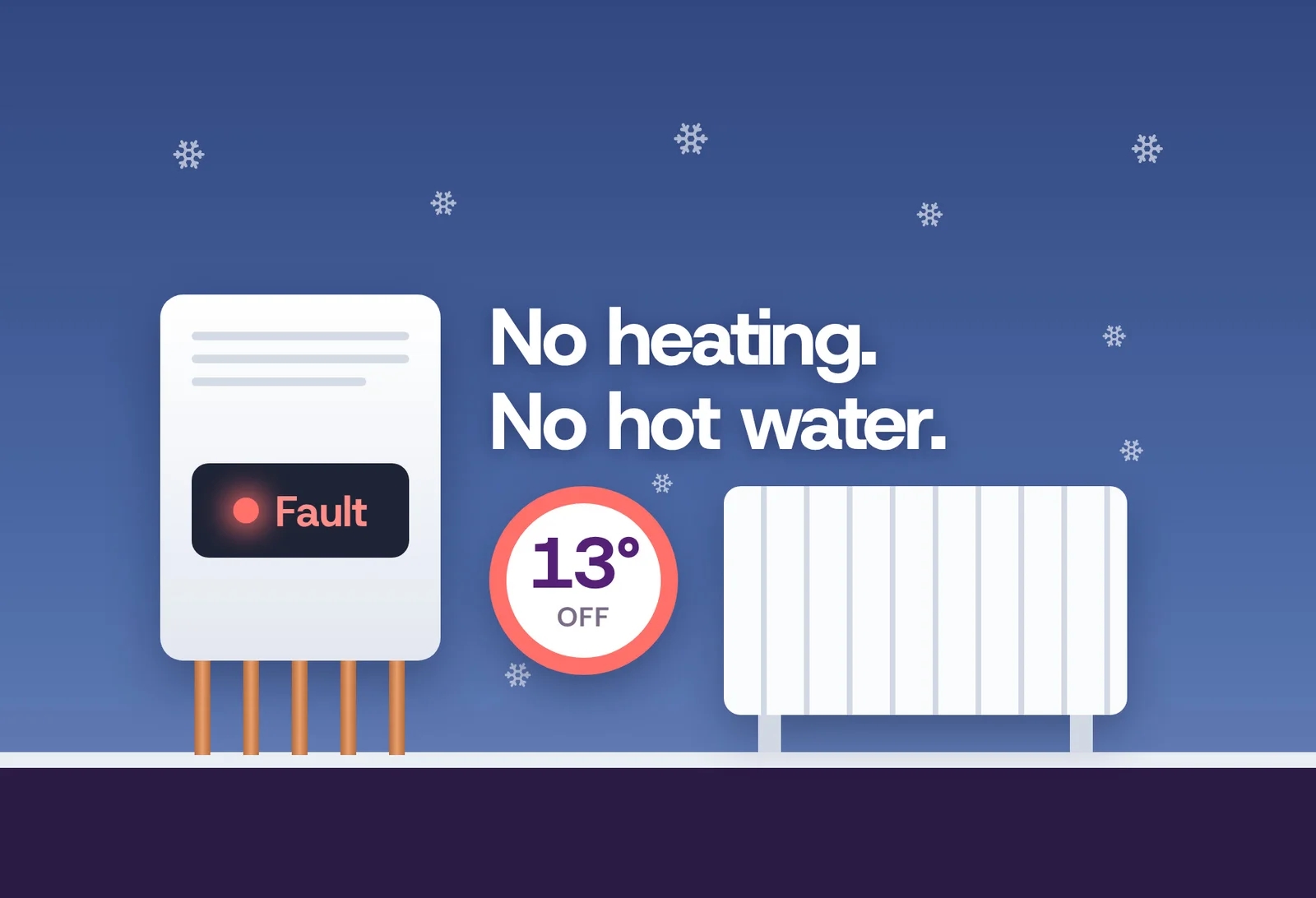
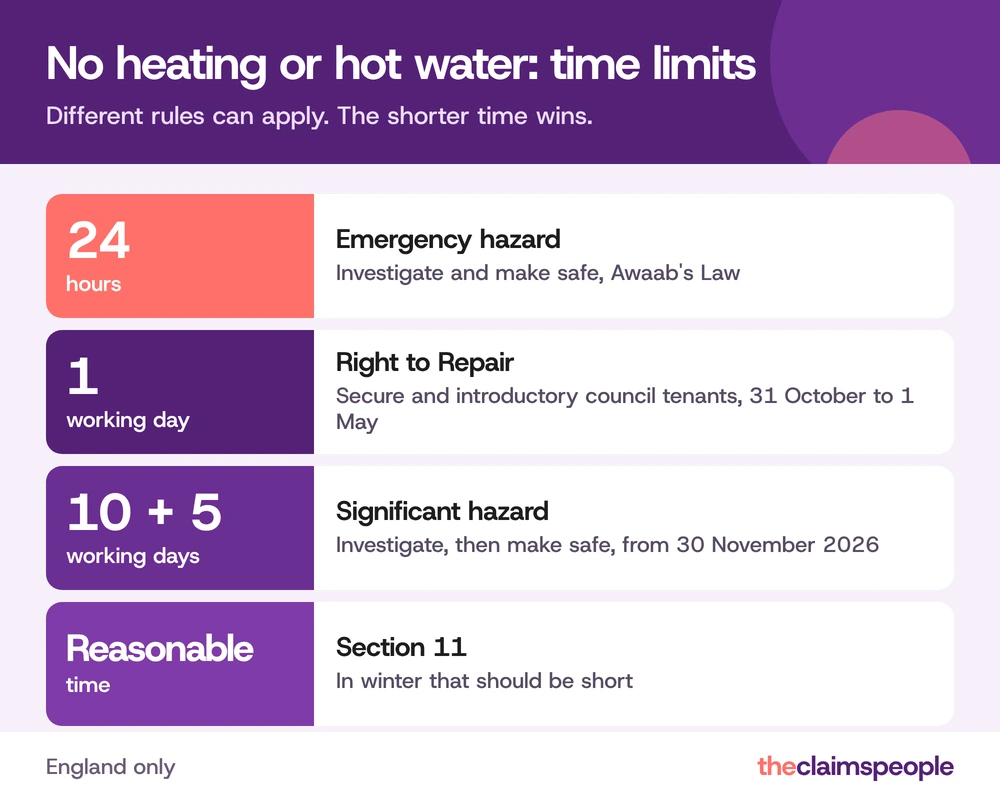
There is no single limit on how long a landlord can leave you without heating. A broken boiler in cold weather could be an emergency hazard. If it is, your landlord must investigate and make your home safe within 24 hours. Many council tenants also have a Right to Repair of 1 working day in winter for smaller repairs.

How long can a landlord leave you without heating?
How long a landlord can leave you without heating depends on how serious it is and who your landlord is. Different rules can apply at once. Where more than one fits, the shorter time applies.
Rule | Who it covers | How long |
|---|---|---|
Awaab's Law, emergency hazard | Council and housing association tenants in England | Investigate and make safe within 24 hours |
Right to Repair | Secure and introductory council tenants in England, for listed repairs the council expects to cost £250 or less | 1 working day between 31 October and 1 May, and 3 working days the rest of the year |
Awaab's Law, significant hazard, from 30 November 2026 | Council and housing association tenants in England | Investigate within 10 working days, then make safe within 5 working days of the investigation ending |
Section 11 | Most council and housing association tenants in England | A reasonable time after your landlord is told, and in winter that should be short |
The legal Right to Repair scheme does not cover housing association tenants, but many housing associations run a similar scheme of their own. Check your landlord's repairs policy.
Is a broken boiler an emergency?
It can be. The government's guidance for landlords lists broken boilers among the hazards that could be an emergency, and says a broken boiler is likely to be more serious in colder months.
What matters is the risk to your household. One of the worked examples in the hazards guidance is an older tenant whose boiler stopped working in January, and it treats that as an emergency.
Emergency hazards have been covered by Awaab's Law since October 2025, so this applies now.
What does make safe mean?
Your landlord may not be able to fix the boiler within 24 hours. Making your home safe can mean temporary measures first, such as portable heaters while the boiler is repaired. They still have to deal with the fault after that.
If they cannot make your home safe in time, they must secure suitable alternative accommodation for your household at their own expense.
How long can a landlord leave you without hot water?
The same rules cover hot water. Your landlord must keep the installation that heats your water in repair and proper working order, and the Right to Repair times above apply to hot water as well as heating.
Losing usable washing facilities can already be an emergency hazard under Awaab's Law. From 30 November 2026, losing hot water so that you cannot wash or clean can also be a significant hazard.
Is your landlord responsible for your boiler?
For what is fitted in your home, almost always yes. In England, under Section 11 of the Landlord and Tenant Act 1985, your landlord must keep the installations for heating and hot water in repair and proper working order. That covers your boiler, radiators, pipes and hot water tank.
Your landlord is not responsible for your energy bills. So before you report it, check the simple things. Is there credit on your gas or electric meter? Is the thermostat or timer set? Has anyone else nearby lost power?
Do not open up the boiler or try to repair it yourself. If you smell gas or think there may be a carbon monoxide leak, call the National Gas Emergency Service straight away on 0800 111 999.
Storage heaters not working?
Fixed storage heaters count as heating installations too. If yours have stopped working and you have checked the switches and your meter, report them in the same way as a broken boiler.
What changes on 30 November 2026
Excess cold joins Awaab's Law. That means a home you cannot properly heat or keep at a safe temperature can have fixed deadlines even when it is not an emergency. The guidance gives the example of a tenant with asthma whose broken window handle stops a living room window from closing, which it treats as a significant hazard.
Awaab's Law is not meant to deliver bigger upgrades such as new insulation across a home. Those are dealt with under other standards. It is aimed at hazards that put your health or safety at risk.
If you reported a cold home months ago and nothing happened, report it again on or after 30 November. Our guide to Awaab's Law Phase 2 explains why that matters.
Cold homes can also be damp homes. If you are seeing water on the glass, read our guide on how to stop condensation on windows.
Who is most at risk in a cold home?
Landlords have to think about who lives in your home. For excess cold, the guidance points to people aged 65 or over, children under 5, pregnant people, people having chemotherapy or radiotherapy, and people with certain long term health conditions.
If any of that applies, say so when you report it. You do not need medical evidence, and landlords should generally take what you tell them at face value.
If you are worried about someone's health, speak to your GP or call NHS 111.
Left without heating and getting nowhere?
Answer 4 quick questions to see what to do next.
Landlord not fixing your boiler? What to do
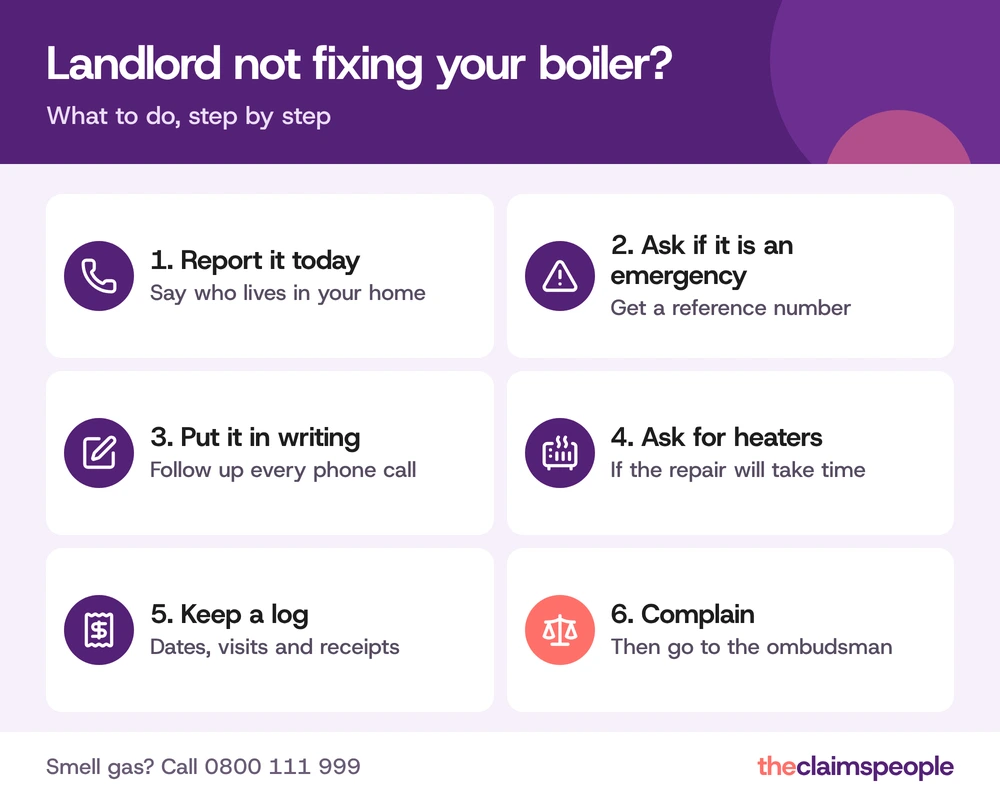
Report it the same day through your landlord's official route. Say when it started and who lives in your home.
Ask if it is being treated as an emergency, and get a reference number.
Follow up any phone call in writing, the same day if you can.
If the repair will take time, ask for temporary heaters.
Keep a log of every day without heat or hot water, every missed visit and everyone you speak to.
Keep receipts for heaters and anything else you have had to buy, and take meter readings if your bills go up.
If nothing happens, use your landlord's complaints process and then go to the Housing Ombudsman in England or the Public Services Ombudsman for Wales in Wales.
If your landlord is a housing association, you can also ask your council's environmental health team to look at it. This works differently if the council is your landlord, so use the complaints route first.
Using the Right to Repair
If you are a secure or introductory council tenant and the first contractor misses the deadline, tell the council you want a different one. If you do not, the compensation stage does not start. If the second contractor misses it too, the council must pay you £10 plus £2 for each extra day, up to £50. It can take off anything you owe it.
The amount is small, but the deadline is useful. It gives you a clear date to work from.
Can you withhold rent for no heating?
Do not stop paying without taking advice first. A broken boiler does not give you an automatic right to stop, and rent arrears can put your home at risk. In Wales, your occupation contract may say rent is not payable while your home is unfit, so take advice on that too.
Can you claim compensation for no heating?
You may be able to, depending on your circumstances. A claim usually comes down to whether you told your landlord, whether you can show it, whether they had enough time to fix it and whether they failed to do so.
A claim can cover getting the work done, compensation for the time you were without heating or hot water, and extra costs you can show. See our page on broken heating claims and our guide to housing disrepair compensation.
Claims like this are normally funded on a no win no fee basis. There is nothing to pay upfront and no fee to us if your claim does not succeed. If it succeeds, deductions apply, and every deduction is set out in writing before you sign anything. Our no win no fee guide explains how it works.
What about Wales?
The timescales and Section 11 rules in this guide apply in England. In Wales, the Renting Homes (Wales) Act 2016 requires your landlord to keep heating and hot water installations in repair and working order, and to keep your home fit for human habitation. We act for council and housing association tenants in Wales too.
Related guides
Frequently asked questions
How long can a landlord leave you without heating?
There is no single limit. If it is an emergency hazard, your landlord must investigate and make your home safe within 24 hours. If it is a significant hazard, the fixed deadlines in the table above apply from 30 November 2026. Otherwise they must repair it within a reasonable time of being told, and in winter that should be short.
How long can a landlord leave you without hot water?
The same rules apply. Secure and introductory council tenants in England have a Right to Repair of 1 working day between 31 October and 1 May, for listed repairs the council expects to cost £250 or less. From 30 November 2026, loss of hot water that stops you washing can also be a significant hazard under Awaab's Law.
Is a broken boiler an emergency repair?
It can be. Government guidance lists broken boilers among the hazards that could be an emergency, and it is likely to be more serious in colder months or where someone in the home is vulnerable.
What counts as an emergency repair for a council tenant?
Anything that could cause immediate harm if not dealt with within 24 hours. Government guidance gives examples such as gas leaks, broken boilers, total loss of water, exposed wiring, major leaks and broken external doors or windows that put your home's security at risk.
Who fixes storage heaters in a council house?
Your landlord. Fixed heating is one of the installations your landlord must keep in repair and proper working order under Section 11.
Does my landlord have to give me heaters?
Government guidance gives temporary heaters as an example of what a reasonable landlord would use to make a home safe while a boiler is fixed. Ask for them when you report it.
Can I stop paying rent if my heating is broken?
Do not stop paying without taking advice first. A broken boiler does not give you an automatic right to stop, and arrears can put your home at risk.
Still cold and still waiting?
If you have reported lost heating or hot water to your council or housing association and it has not been fixed, you may be able to pursue repairs and compensation, depending on your circumstances. Free to check, no obligation.
Check if you can claimThis page is general information, not legal advice. Every claim turns on its own facts. Speak to a qualified solicitor about your circumstances. Last checked 5 November 2026.