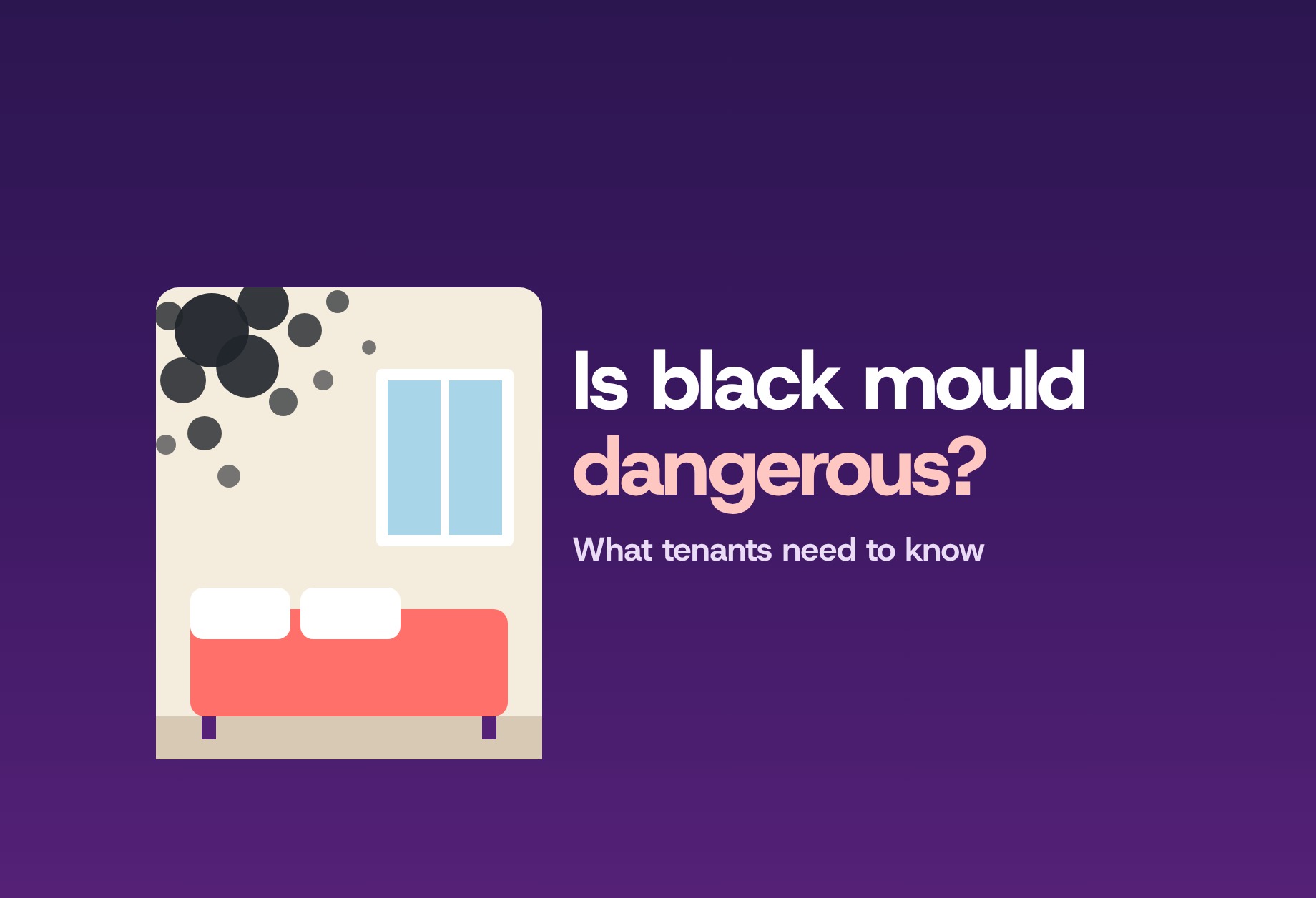
Is black mould dangerous? It can be. The government says damp and mould can harm your lungs, airways, eyes and skin, and can affect your mental health. Children, older people and anyone with a health condition face a higher risk. If it is in your council or housing association home, report it now.

Is black mould dangerous?
Yes, it can be. Mould gives off allergens, irritants and spores that can harm your health. The government's guidance on damp and mould says the effects on your breathing can cause serious illness and, in the most severe cases, death.
That is what happened to Awaab Ishak. He was two years old when he died of a severe respiratory condition caused by long exposure to mould in his home in Rochdale. His case is why Awaab's Law exists.
Most people living with mould will never become that ill, and we are not saying that to frighten you. But mould in your home should be taken seriously.
Is all black mould the same?
Colour is not the test. The government's guidance does not sort mould by colour. It treats damp and mould together as a health risk. You do not need a test to find out what type you have before you report it. If it is growing in your home, that is enough.
What are the symptoms of black mould?
The government's guidance lists these effects:
Cough, wheezing and shortness of breath
Asthma that starts or gets worse
Blocked or runny nose, known as rhinitis
Sore, irritated eyes, including allergic conjunctivitis
Eczema, itchy patches and skin rashes
Airway and fungal infections, especially if your immune system is weak
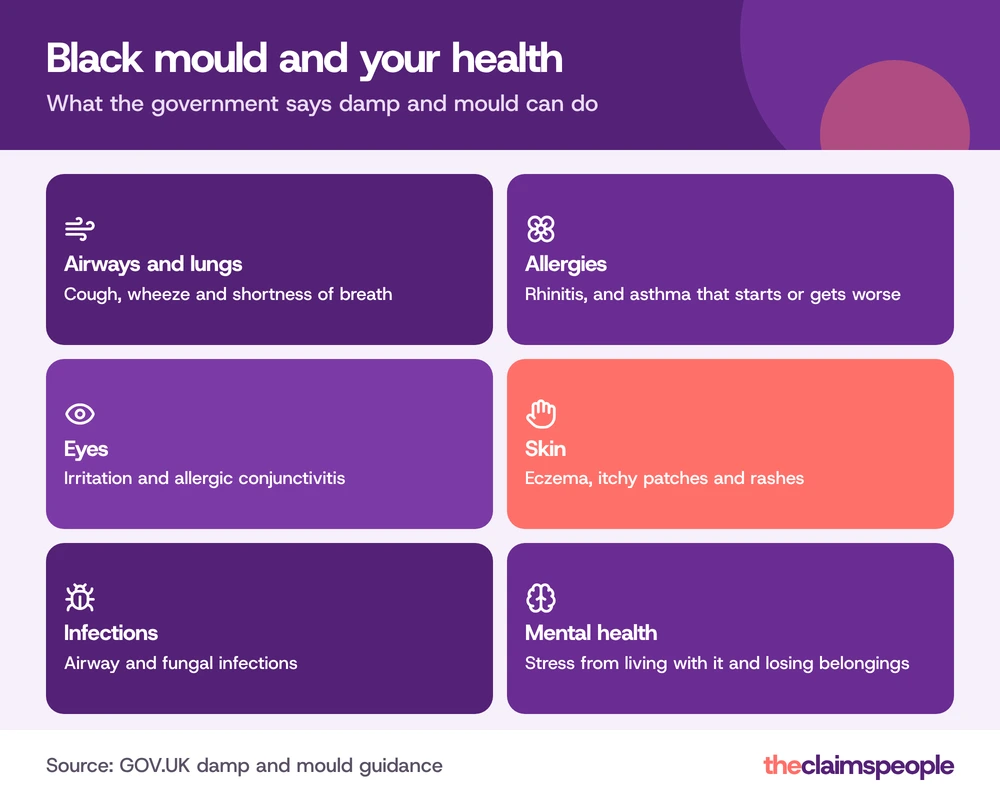
Living with it can wear you down too. The guidance says damp and mould can harm mental health, from the conditions themselves and from having your belongings ruined.
Having these symptoms does not prove mould caused them. Only a doctor can look at that. If you are worried, speak to your GP or call NHS 111, and tell them about the mould. If someone is struggling to breathe, call 999.
Check your home
Is black mould dangerous to breathe in?
It can be, and this is the main concern. Mould spreads by releasing tiny spores into the air, and damp and mould mainly affect the airways and lungs.
Is black mould in a bedroom dangerous?
Black mould in a bedroom deserves quick action, because that is where you spend most hours breathing the same air. It often grows on cold outside walls and low down behind wardrobes and beds, where air does not move. If it is in a child's bedroom, say so when you report it.
Where black mould tends to grow
Tap a room to see what to look for.
Bedroom. Look behind wardrobes and beds, in the corners of outside walls and around the window.
Read more: How to stop condensation on windows
Bathroom. Look at the ceiling, around the window and on the sealant. Check that the extractor fan works.
Kitchen. Look inside cupboards on outside walls, behind appliances and under the sink, where a slow leak can hide.
Read more: Water leak claims
Hidden mould. A musty smell with nothing to see can mean mould behind furniture, pipes or wallpaper. Report it. Pulling off wallpaper or carpet can release a lot of spores.
Read more: Damp and mould claims
Who is most at risk from black mould?
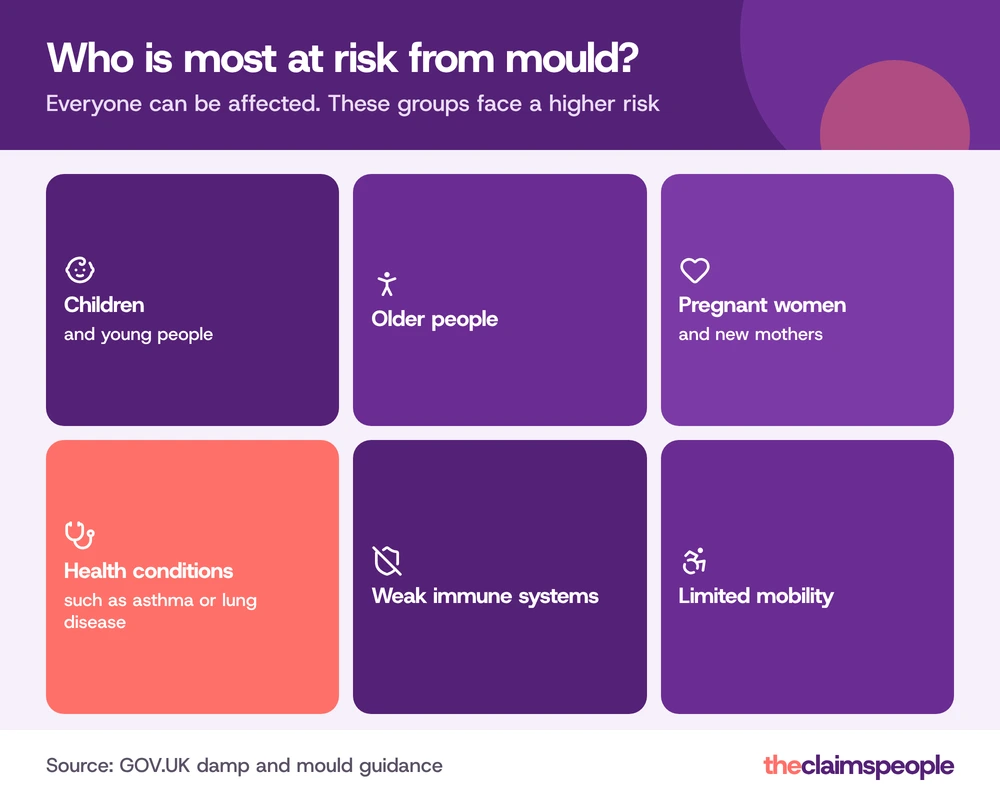
Everyone can be affected, but some people face a higher risk. The government's guidance names these groups:
Is black mould dangerous for babies and children?
Children are one of the higher risk groups in the guidance, because their bodies are still developing. Shelter suggests asking health workers, such as a midwife or health visitor, if they can give you information to send to your landlord.
You do not need that letter before your landlord acts. The guidance says medical evidence is not needed, and that landlords should not wait for it.
Is it safe to live in a house with black mould?
That depends on how bad it is and who lives there. A doctor is the right person to ask about your health.
In England, if damp or mould could cause immediate harm, for example where it is widespread and affecting someone's health, it can be an emergency hazard. Your landlord must then investigate and make your home safe within 24 hours. If they cannot make it safe in time, they must secure suitable alternative accommodation at their own expense.
Should you clean black mould yourself?
Very small patches can usually be cleaned by tenants. Larger areas should be left to professionals. The government's guidance recommends mould and mildew products rather than bleach, and protective equipment while you do it.
Before you touch anything, take dated photos. Once it has been wiped away you have lost your evidence, and our guide on how to stop condensation on windows explains why it often comes back. The guidance is clear that removing surface mould alone will not stop it reappearing. The cause has to be dealt with.
Is black mould your landlord's responsibility?
It can be. It depends on what is causing it. In England, under Section 11 of the Landlord and Tenant Act 1985, your landlord must keep the structure and outside of your home in repair, along with the heating and other installations. A leak, a rotten window, broken heating or a damaged roof can all lead to mould.
Your landlord must also keep your home fit to live in, and freedom from damp is one of the things a court looks at. See landlord repair responsibilities.
If you are told it is your fault for drying clothes or not opening windows, know that government guidance says it is unacceptable for landlords to assume this. It accepts that cooking, bathing and drying laundry all produce moisture.
How fast must your landlord act on black mould?
In England, Awaab's Law sets deadlines for council and housing association landlords where damp and mould poses a significant risk to your health or safety.
What must happen | Significant hazard | Emergency hazard |
|---|---|---|
Investigate | Within 10 working days of your landlord becoming aware | Within 24 hours of your landlord becoming aware |
Written summary | Within 3 working days of the investigation ending, unless all the work is finished by then | Within 3 working days of the investigation ending, unless all the work is finished by then |
Make your home safe | Within 5 working days of the investigation ending | Within 24 hours of your landlord becoming aware |
Working days leave out weekends, Christmas Day, Good Friday and bank holidays, and each period starts the day after the event that sets it off. The 24 hour clock starts as soon as your landlord becomes aware.
Work out your landlord's deadlines
In England. Pick the problem and the date you told them.
How to report black mould
Take dated photos in daylight, including any damaged belongings.
Report it through your landlord's official route. Use the words damp and mould, and say how long it has been there.
Say who lives in your home and whether anyone's health is affected. You do not need medical evidence.
Keep a copy of what you sent, with the date and any reference number.
If you want a visit rather than a photo check, ask for an in person inspection.
If nothing happens, use your landlord's complaints process and then go to the Housing Ombudsman in England or the Public Services Ombudsman for Wales in Wales.
Reported black mould and still waiting?
Answer 4 quick questions to see what to do next.
Can you claim if black mould has affected your health?
You may be able to, depending on your circumstances. A claim usually comes down to whether you told your landlord, whether you can show it, whether they had enough time to put it right and whether they failed to do so.
A claim can cover getting the work done, compensation for the time you have lived with the problem and belongings that have been damaged. Any health problem is looked at separately, on medical evidence. Our pages on damp and mould claims and damp and mould rights and compensation explain more.
Claims like this are normally funded on a no win no fee basis. There is nothing to pay upfront and no fee to us if your claim does not succeed. If it succeeds, deductions apply, and every deduction is set out in writing before you sign anything. Our no win no fee guide explains how it works.
What about Wales?
Awaab's Law applies in England only, and Section 11 does not apply to occupation contracts in Wales. Instead, the Renting Homes (Wales) Act 2016 requires your landlord to keep your home in repair and fit for human habitation, and damp and mould growth is one of the matters looked at. Since 1 April 2026, the Welsh Housing Quality Standard has also set timescales for social landlords. Where disrepair poses a significant risk, the limits are 24 hours to investigate and a further 24 hours to put it right if harm is likely to be imminent, or otherwise 10 working days and a further 5 working days. Complaints go to your landlord first and then to the Public Services Ombudsman for Wales.
Related guides
Frequently asked questions
Is black mould dangerous?
It can be. Damp and mould can affect your lungs, airways, eyes and skin, and can harm your mental health. The risk is higher for children, older people, pregnant women and people with health conditions.
What are the symptoms of black mould?
Government guidance lists cough, wheezing, shortness of breath, asthma that starts or gets worse, a blocked or runny nose, sore eyes, eczema and skin rashes, and infections. Speak to your GP if you are worried.
Can mould make you ill?
Yes, it can. Mould releases allergens, irritants and spores that can cause or worsen breathing problems and skin and eye irritation. How it affects you depends on your health and how much mould there is.
Is black mould in a bedroom dangerous?
It can be, because you spend so many hours breathing the same air there. Take photos, report it to your landlord and say if it is in a child's bedroom or if anyone's health is affected.
Is it safe to live in a house with black mould?
That depends on how bad it is and who lives there, so ask your GP about your health. In England, if the mould could cause immediate harm, your landlord must investigate and make your home safe within 24 hours.
Should I clean black mould myself?
Very small patches can usually be cleaned by tenants, using a mould and mildew product rather than bleach. Take dated photos first, and wear a mask, gloves and goggles. Larger areas should be left to professionals, and the cause still has to be dealt with.
Do I need a doctor's letter to report mould?
No. Government guidance says medical evidence is not needed and landlords should not wait for it. If you do have a letter, include it, because your landlord should consider it.
Living with black mould and still waiting?
Tell us what the problem is and when you reported it. Depending on your circumstances, you may be able to pursue repairs and compensation for the time you have lived with it. Free to check, no obligation.
Check if you can claimThis page is general information, not legal advice. Every claim turns on its own facts. Speak to a qualified solicitor about your circumstances. Last checked 5 November 2026.